

Publications & Scientific Evidence
Research Publications & Scientific Evidence
WiMoCSI combines mathematical analysis, physics-based simulation, and commodity Wi-Fi CSI experiments to study human motion, walking-speed recovery, uncertainty, and failure-aware estimation.
Findings support ongoing research toward future contactless mobility monitoring and aging/ADRD applications. This is not a clinically validated monitoring product.

Journal manuscripts
Finite-Observation Identifiability for WiFi-Based Mobility Monitoring: Exact Bessel-Correlation Algebra and Local Separation
Theme: Exact structural identifiability of a finite Wi-Fi motion statistic derived from recorded packet timestamps.
DraftMathematical workflow showing how recorded timestamps and a finite 32-bin observation lead to exact local identifiability results. Reliability Limits of WiFi-Based Mobility Monitoring: Certified Separation and Numerical Recoverability
Theme: Certified separation, numerical recoverability, and reliability limits in Wi-Fi-based mobility monitoring.
DraftCertified separation does not by itself ensure reliable numerical recovery under finite precision and noise. Acquisition-Conditioned Information Limits for WiFi-Based Mobility Monitoring: Packet Loss and Irregular Sampling
Theme: Fisher-information limits of Wi-Fi motion statistics under packet loss, irregular sampling, nuisance amplitudes, and acquisition-dependent uncertainty.
DraftConditional Fisher-information analysis of packet loss, irregular sampling, and 32-bin compression.
Conference papers and abstracts
A Universal Weak-Separation Ratio in a Commodity WiFi Channel-State Motion Model
NRSM 2027 · National Radio Science Meeting · Accepted for oral presentation
Accepted (Oral)Universal weak-separation ratio at z₂/z₁ ≈ 1.8633: leading-order certification vanishes, while next-order separation remains under the stated conditions. Walking-Speed Sensing with WiFi CSI: Ray-Traced Recoverability and Commodity-WiFi Corroboration
ICNC 2027 · Manuscript
ManuscriptRay-traced speed recovery achieves 1.30–2.41% error; Intel AX201 measurements preserve speed ordering but do not meet the calibrated-recovery criterion (31.18% MdAPE). Evidence-Aware Web of Things Interoperability for Wi-Fi Sensing in Aging-in-Place Applications
CCWC 2027 · Manuscript
ManuscriptEvidence-aware WoT interoperability preserves consumer decisions and canonical evidence across different service representations. WiMoCSI: A Physics-Based Virtual Laboratory for Human Motion and Indoor Wi-Fi Scattering
APS 2027 · Conference abstract
AbstractWiMoCSI compares propagation models under controlled human motion, revealing speed-estimation sensitivity to scattering assumptions and antenna geometry. When Periodicity Is Not Enough: A Retrospective Study of Failure-Aware Wi-Fi CSI Lap-Period Recovery
Conference manuscript · Draft
DraftAccurate CSI repetition periods do not necessarily establish verified walking bouts, lap counts, or bout boundaries.
Experimental studies
Experimental reports document what was measured and how. Each study below is also listed in the papers above; here it is described by the measurement it reports rather than by its publication form.
Experimental Report
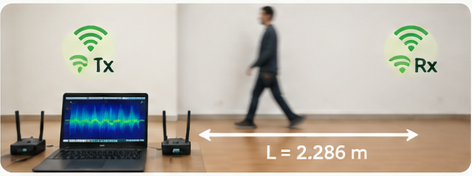
Walking-Speed Sensing with WiFi CSI: Ray-Traced Recoverability and Commodity-WiFi Corroboration
Commodity Wi-Fi CSI recorded during walking trials, compared against independently timed walking and ray-traced recoverability.
ICNC · Manuscript
Retrospective Analysis
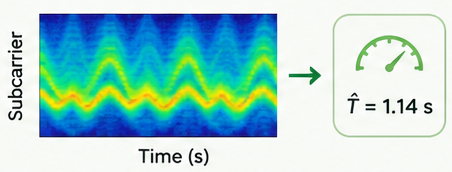
When Periodicity Is Not Enough: A Retrospective Study of Failure-Aware Wi-Fi CSI Lap-Period Recovery
Retrospective, failure-aware recovery of lap periods from recorded Wi-Fi CSI, where an ambiguous periodic signal is withheld rather than reported.
Conference manuscript · Draft
Simulation Study
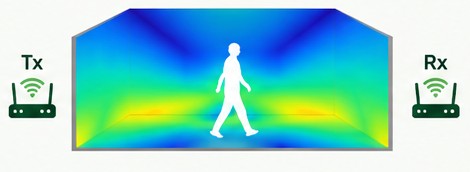
WiMoCSI: A Physics-Based Virtual Laboratory for Human Motion and Indoor Wi-Fi Scattering
Physics-based simulation of human motion and indoor Wi-Fi scattering, with room geometry, antennas, and walking motion set to generate CSI.
APS · Conference abstract
Experimental figures and video walkthroughs for these studies are still being prepared.