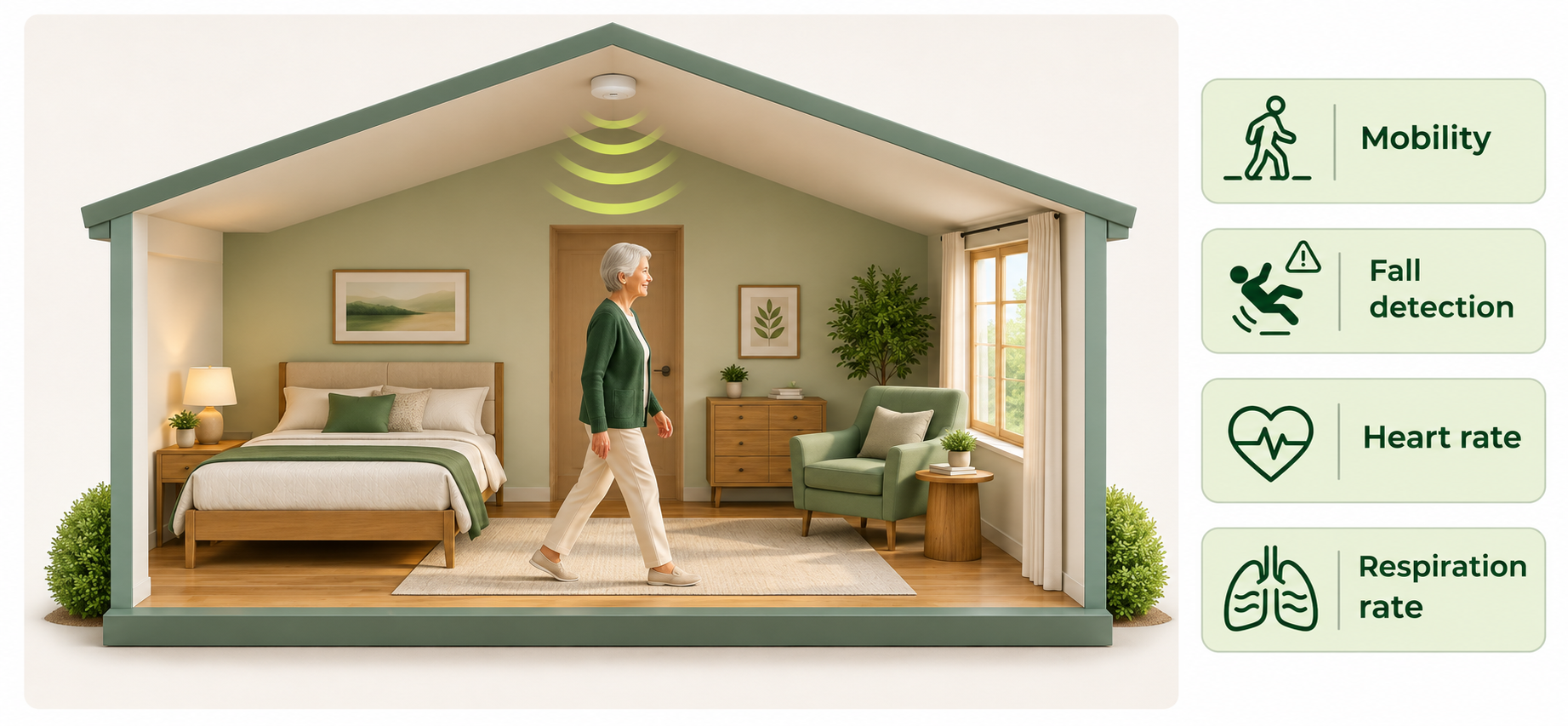
For millions of older adults, living independently means maintaining mobility, health, and safety. Yet meaningful changes in walking speed, daily activity, and physical function can develop gradually, often between occasional healthcare visits.
Research in healthy aging and Alzheimer's disease and related dementias (ADRD) has shown that changes in mobility can provide important insights into physical and cognitive health.
Inspired by research at Portland State University and OHSU's ORCATECH, WiMoCSI addresses a fundamental question: Can the Wi-Fi already present in our homes help us understand changes in mobility without cameras or wearable devices?
Our Vision for Everyday Care
We are developing Wi-Fi-based sensing technology that could transform ordinary wireless signals into useful information about human movement and mobility.
Today, WiMoCSI focuses on motion detection, walking-speed estimation, and scientific validation through simulation and controlled measurements.
Through Care Aware Tech, our longer-term vision is to extend this research toward continuous, privacy-conscious health monitoring for older adults, including fall detection, breathing, and heart-rate monitoring.
Our goal is to help make aging in place safer and more independent, while supporting future research into cognitive health and neurological disease.
Why Everyday Mobility Matters
Walking and Brain Health
Changes in walking speed and gait have been associated with cognitive decline and dementia risk. Understanding everyday mobility may provide researchers with valuable insights into healthy aging.
Detecting Changes Earlier
Subtle changes in mobility and daily activity can develop between healthcare visits. More frequent, objective measurements could help researchers study functional decline and fall risk.
Monitoring Without Wearables
WiMoCSI explores how ordinary Wi-Fi signals can detect movement and estimate walking speed without cameras or wearable devices, laying the groundwork for future continuous, privacy-conscious home monitoring.
How Wi-Fi sensing works
Video walkthrough coming soon
Walking trial
CSI measurement
Estimate or withhold
Imagine an older adult walking through their home or the hallway of a senior living community. As they move, their body subtly changes how Wi-Fi signals travel and reflect throughout the space. WiMoCSI analyzes these changes using Channel State Information (CSI) from compatible Wi-Fi devices to detect movement and estimate walking speed, without cameras or wearable devices. By combining advanced signal processing with reliability checks, we investigate how accurately Wi-Fi can measure everyday mobility. Our long-term vision is to help caregivers and researchers recognize meaningful changes in mobility, supporting safer independent living, healthy aging, and proactive care.
Research Areas — Wi-Fi Sensing for Healthy Aging
Mobility, Aging & Cognitive Health
Current mobility research · Future ADRD applications
Using Wi-Fi sensing to detect movement and estimate walking speed, with the long-term goal of investigating mobility changes associated with Alzheimer's disease and related dementias (ADRD) and healthy aging.
Fall Detection & Independent Living
Future research direction
Developing approaches toward contactless fall and near-fall detection to support older adults, including people living with cognitive impairment, in homes and senior living communities.
Contactless Vital Sign Monitoring
Future research direction
Exploring Wi-Fi-based breathing and heart-rate monitoring as a step toward continuous, unobtrusive health sensing for aging-in-place and senior care applications.
Evidence and publications
Journal Manuscripts
Foundational theory, numerical recoverability, and reliability.